Boxing Forums


User Tag List

Thanks Thanks:  0
Likes Likes:  0
Dislikes Dislikes:  0
Results 1 to 15 of 23

Thread: The GODS OF WAR

Share/Bookmark

Hybrid View

Previous Post Previous Post   Next Post Next Post
  1. #1
    Join Date
    Oct 2010
    Location
    Northern Canada
    Posts
    9,793
    Mentioned
    86 Post(s)
    Tagged
    0 Thread(s)
    Punch Power
    1028
    Cool Clicks

    Default Re: The GODS OF WAR

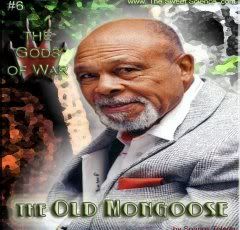
    The Sixth God of War: Archie Moore

    By Springs Toledo


    “Time is a strange brew.”
    ~ Archie Moore

    Archie Moore may have needed smelling salts to revive him after hearing that he was finally getting a crack at the light heavyweight title after 160 professional bouts. He was lucky he didn’t break his hip when he fell. The “Old Mongoose” turned thirty-six years old four days before he stepped into the ring against champion Joey Maxim during the Yuletide season of 1952.

    Moore was aging all right, but he was an aging puncher, and that meant something. His legs were stuck in cement, which only made it easier to plant his feet and launch the dynamite in his fists. Do you remember your grandfather’s vice-grip of a handshake? Men get stronger as they age.

    Moore was always a powerful fighter and partially because of that, an avoided fighter. He had been ranked as a middleweight from 1940 through 1944 and ranked as a light heavyweight for the next eight years. Two of his most dangerous opponents had already retired by the time he fought Maxim: Charley Burley in 1950 and Eddie Booker in 1944. Neither of them was able to get a world title shot and all three had to take jobs outside of boxing at one time or another: Burley at an aircraft plant, Booker as a red cap porter, and Moore as a night watchman. “I am often asked why, when both Burley and Booker beat me, neither one got to the top whereas I did,” the introspective Moore said, “Well, I guess it’s the way I sized things up. I felt I had two opponents –other boxers and Father Time.” Discouragement, he said, “can KO a boxer even before he has a chance to step into the ring.”

    Moore may have had a main event against Father Time, but he never forgot those preliminary brawls early in his career. After a three month, seven fight jaunt in Australia in 1940 he dropped anchor in California at the age of twenty-three and joined the round-robin ranks of other great black boxers then campaigning on the west coast. Moore and the set remembered as ‘Murderers’ Row’ fought among themselves like lions for peanuts not far enough from the San Diego Zoo. All told, Archie Moore, Charley Burley, Eddie Booker, Jack Chase, Lloyd Marshall, Tiger Wade, Bert Lytell, as well as Holman Williams and Cocoa Kid fought each other 79 times. Archie’s record against them was 10-5-3 with 4 knockouts, which was about as good as it got.

    Those internecine wars furnished each of them with a wealth of experience but their purses weren’t even enough to furnish a house …and they opened no doors.

    A frustrated Charley Burley hung up the gloves and took a job as a garbage man for the city of Pittsburgh. Eddie Booker retired after an eye injury got progressively worse. Bert Lytell had his last fight when he was just twenty-seven years old. In 1951 he was at Grossinger’s gym in New York sparring with world middleweight champion Randy Turpin before Turpin’s rematch with Sugar Ray Robinson. Jack Chase, Lloyd Marshall, Holman Williams, Tiger Wade, and Cocoa Kid retired in their mid-30s due to fading skills, a devastating loss, or both.

    Bitterness was a contagion for ignored fighters like the Mongoose and Murderers’ Row. Perhaps Moore’s greatest triumph was an emotional one. He had developed ulcers that ruptured the day after a brutal bout with Booker and landed him in the hospital for thirty-eight days. He was close to death. After self-diagnosing the spiritual causes of his ailment, he picked up a mirror and saw a face etched with tension. It was the face of millions of African American men seething under the surface, held down by invisible chains. Moore found that he was holding on to negative feelings in his heart and it had done a number not only on his health, but on his character. He wrote his own prescription for healing remedies that predated the New Age movement by three decades –he listened to jazz, learned to take therapeutic naps, mastered his pseudo-scientific theories of “breathology,” “escapism,” and “relaxism” and overcame what ailed him.

    It was an achievement that stands as a monument to inspire us all. Moore went deep into an internal cave and battled the dragons lurking in his own humanity. What emerged was a philosopher-king who took hold of a grand mission and slung it on his back. He would not only honor an old promise made to his aunt to refrain from drinking, smoking, or “doing anything shameful in the ring,” he also made a new one to himself. Before George Foreman was even born, Archie Moore would ignore time and its creaking warnings and force his way through the gates of a kingdom that was rightfully his.

    “I know I can beat Maxim,” he told reporters, “I always did believe I could beat him.”

    A.J. Liebling agreed. Moore reminded him of “a supreme exponent of bel canto who sees himself crowded out of the opera house by a guy who can only shout.” The perennial top contender took matters into his own hands and began writing letters to sports editors all over the country. “I pleaded, I cursed,” he remembered, “I demanded a shot at Maxim's crown.” Joey Maxim’s manager was the go-to man and it just so happened that Maxim’s manager was Doc Kearns, the same Doc Kearns who once managed Jack Dempsey and Mickey “Toy Bulldog” Walker. By this time Kearns had snow on the roof, but his greediness was evergreen; he finally yielded and allowed a title shot but only after he received a guaranteed purse of $100,000 for Maxim. Moore signed, even though his end turned out to be a measly $800.

    Most fight fans knew what was what and who was who and the odds reflected that –twelve to five against the champion. Losing was unthinkable for Moore, who remembered well the trials of Charley Burley. “I’ve been waiting a long time,” he said with quiet intensity, “I’ve got to win.”

    He had another reason to win, another motivation that fluttered deep inside of him. He took the time to make arrangements for his divorced parents to sit ringside at the arena in St. Louis. A man who banishes bitterness from his heart does funny things, and this man forgave them for sending him away to his aunt and uncle when he was barely a year old. “I just wanted my father and my mother to see me win the title, together,” he told Sports Illustrated in 1989. “I wanted to look down on them, next to each other, at that moment. And I did.”

    Moore then turned his attention to the king on his throne, on his throne.

    The bell rang. In a few minutes it became clear that it was ringing for one and tolling for the other. A right hand dented Maxim’s square jaw in the first round and he forced a clinch. Maxim, born Giuseppe Antonio Berardinelli, had a repeating left jab that recalled a Maxim machine gun; thus the name. As the all-time knockout leader (Moore had at least 131 career KOs) applied his hardware and demonstrated superior technical know-how, Maxim’s own considerable skills were neutralized and his jab shot blanks. After the seventh the champion was hurt in every round. “Time and again,” said the Associated Press, “Moore unleashed the full fury of almost a decade of frustration as the ‘uncrowned champion.’”

    Kearns may have finagled a $100,000 retirement fund for the inevitable dethronement of his boy, but some of those funds had to be earmarked for medical bills. Joey Maxim was gashed and swollen when his crown fell off. Moore caught that crown with nimble hands. His manager attempted to lift him in the air to celebrate but Moore would have none of it. “Just slip my robe on my shoulders,” he ordered, “There's nothing to get excited about. I could've won this thing 12 years ago if I'd had the chance.”

    Only minutes after his victory, the new old champion announced his intentions. “I’m going to put some life in the division. Any contender who deserves a chance will get it.” And the Old Mongoose was every bit as good as his word. His predecessors’ sins of avoidance were spotlighted by Moore who faced all-comers including Maxim, twice.

    With this remarkable victory, Moore was escorted out of what he called “the murky twilight” and into the radiance of fame and celebrity. It was long overdue. The charismatic light heavyweight king was interviewed often and would not allow the public to forget the names of those fierce, forgotten men he faced in his youth. He would tip his crown to them and his humanity shined when he did.

    It is poignant when you think about it. But for his longevity and acute single-mindedness, the name ‘Archie Moore’ would surely have been added by history to the ranks of Murderers’ Row –as another great coulda’ been. Instead, he became the unlikeliest of destiny’s children, an old man spanking top contenders for the sheer fun of it.

  2. #2
    Join Date
    Oct 2010
    Location
    Northern Canada
    Posts
    9,793
    Mentioned
    86 Post(s)
    Tagged
    0 Thread(s)
    Punch Power
    1028
    Cool Clicks

    Default Re: The GODS OF WAR

    Cont...

    Late wars followed his ascension to the purple, including the street fight against Yvon Durelle and memorable campaigns in the heavyweight division against Rocky Marciano and Muhammad Ali. The names on Moore’s resume read like graffiti at the Roman Pantheon. One of those names was Jimmy Bivins whom he had beaten three times. When asked who was the greatest of the eleven world champions he faced, Bivins told The Ring, “the one guy who stands out –and he stands out in everyone’s mind –is Archie Moore. I thought he was the greatest fighter in the world. He could punch and he could box. But he could really punch. He wasn’t afraid of nobody.”

    Archie came out of boxing’s golden era, when men fought more often for less money and the working conditions were more hazardous than they are today, to say the least. He managed to defeat world-class middleweights, light heavyweights, and heavyweights, though he was essentially only a natural middleweight with a paunch. He overcame six Hall of Famers. The record should read seven; a prime Willie Pastrano escaped with a hotly disputed draw after Archie chased him around the ring on forty-five year old legs. That was in 1962. Archie had his first professional fight in 1935.

    Many civilians cannot understand why anyone would choose Archie’s profession for a living, and even fighters themselves would be hard-pressed to explain how a man could fight 220 times over twenty-eight years. Placing one’s health and wellbeing at such risk so often for so long seems to be utter folly, if not madness. Moore was an exception that proved the rule. He was the antique that out-performed newer models, a well-mannered eccentric who would show up at weigh-ins resplendent in a top hat and tuxedo, twirling a walking stick. At times he’d step onto the scale buck naked. And even had he been a bit mad, there was a touch of genius in it –the old man’s showmanship compounded the staggering skillfulness of his craft and boosted box-office receipts.

    In the end, Archie Moore’s motivation was neither madness nor money.

    It was love.

    “Boxing is magnificent,” he told a journalist late in life, his eyes softening with affection. “It’s beautiful to know. Oh, the price can be very dear. You’ve got to marry it. And so I did. Boxing was my lover. It was my lady.”

  3. #3
    Join Date
    Oct 2010
    Location
    Northern Canada
    Posts
    9,793
    Mentioned
    86 Post(s)
    Tagged
    0 Thread(s)
    Punch Power
    1028
    Cool Clicks

    Default Re: The GODS OF WAR

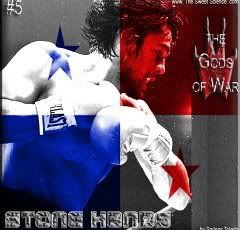
    The Fifth God Of War: Roberto Duran

    By Springs Toledo


    “Yield to the god.”
    ~ Virgil, the Aeneid

    The battered and bloodied world welterweight champion Barney Ross glowered at his three corner men as the thirteenth round was about to begin. “If you stop this fight,” he said, “I’ll never talk to you the rest of my life.” In the opposite corner, a surging Henry Armstrong sprang out of his corner at the bell. Trainer Ray Arcel, a cotton swap in his mouth, watched the last three rounds with Ross’s words echoing in his ears and a prayer on his lips. He prayed not that Barney would win, but that Barney would survive.

    The defeated boxer was brought back to the hotel where Arcel put hot towels on his swollen face and tended to his wounds. He stayed with him for four days and four nights.

    That was 1938. Arcel was already in the fight game twenty years. He was in New York City at the beginning, when a troupe of great Jewish boxers left Grupp’s gym in Harlem and walked nine blocks north to Stillman’s gym. Arcel would teach hundreds of young men how to fight, including twenty world champions. His first was Frankie Genaro in 1923. His last was fifty years later.

    Arcel met Freddie Brown at Stillman’s. Brown grew up on Forsythe Street in the Lower East side not three miles from Benny Leonard’s house. He began training in the 1920s and had what A.J. Liebling described as the unmistakable appearance of old fighters: “small men with mashed noses and quick eyes” and a chewed-up stogie stuck on his lip that contrasted nicely with the clean cotton swap of Arcel.

    MANGOS
    Twenty-year-old Roberto Duran’s American debut was at Madison Square Garden. Thirteen thousand, two hundred and eleven ticket-buyers watched him lay out Benny Huertas like a door mat in sixty-six seconds. Dave Anderson covered the fight for the New York Times. “Remember the name –,” he advised.

    A startled Ray Arcel saw that stone fist land on Huertas’ temple from an aisle seat. As the Panamanian left the ring on his way to the dressing room he startled the old man again with a polite greeting for him and his wife. A month later Duran would be introduced to Freddie Brown and the triumvirate would be complete.

    “When I came into his camp in 1972, he was just a slugger until I taught him finesse,” Brown remembered. A slugger? Duran was worse than that. He was a savage. Duran was a Roman wolf-child placed in a civilizing school where the arts of war were taught by ancient masters. Like Agrippina summoned Seneca to tutor a young Nero, Duran’s manager summoned Arcel. Arcel brought in Freddie Brown. It took not one, but two eminent trainers to tame Duran, and Brown bore the brunt of it –camping outside of his door to chase away the girls, waking him up early in the morning to do his roadwork, locking the cupboards.

    The two old men never did completely civilize their pupil, though they did better than Seneca –Nero became emperor and used Christians as human torches to light the streets of Rome. Duran listened, and because he listened his mind was filled with a century’s worth of ring knowledge.

    In 1972 Duran indecently assaulted lightweight champion Ken Buchanan and snatched his crown. His reign of terror lasted six years and twelve title defenses.

    “The only guy we had like him,” Brown told Pete Hamill, “is Henry Armstrong.” Arcel trained Armstrong after Ross retired and understood the intricacies of explosive boxing. Both trainers knew the value of intelligence in the ring. “Boxing,” said Arcel whenever the subject came up, “is brain over brawn…if you can’t think, you’re just another bum in the park.” Duran was not only “one of the most vicious fighters we’ve ever had,” said Brown, he was “one of the smartest.”

    George Herbert once said that “a great ship asks deep water.” Roberto Duran didn’t ask, he invaded the welterweight division when it was as deep as it ever was. Waiting for him were two bangers in Pipino Cuevas and Thomas Hearns, defensive specialist Wilfred Benitez, boxer Carlos Palomino, and the smiling celebrity who lorded over them all –the boxer-puncher Ray Leonard.

    MALICE
    By the end of 1979 a clash between Leonard and Duran was almost certain. Duran had already retired former welterweight champion Palomino in a dominant performance, while Leonard stopped Benitez and took his title. They fought separately on the Larry Holmes-Ernie Shavers undercard and Leonard’s trainer Angelo Dundee watched the Duran bout very carefully. “Duran is thought of as a rough guy, but he’s not rough,” he observed, “he’s smart and slick.”

    Arcel, 81 and Brown, 73 were watching Leonard as well, though they were very familiar with his style and how to beat it. They had already trained about thirty world champions between them, while the fifty-eight year old Dundee had nine on his resume. In fact, Dundee’s novitiate was at Stillman’s gym where he handed towels to the two masters he now matched wits with.

    The posturing began soon enough. At Gleason’s gym, Leonard was watching Duran skip rope when Duran spotted him and began lashing the rope with uncanny speed –while squatting. At a press conference at the Waldorf-Astoria Hotel in New York City, Leonard was cuffed by Duran, who claimed that Leonard put his hand near his face. Two days before the fight, both men were at an indoor mall in Montreal and Duran learned just enough English to yell “two more days! Two more days!” Leonard blew a kiss and Duran charged at him and had to be restrained.

    Duran was getting mean, but it was Leonard who had every physical advantage in his favor. He was younger, faster, taller, and bigger. “I’m not Ali,” he insisted to the pundits, “Sure, maybe at the start I was trying to do his shuffle or his rope-a-dope, but not now.” In his last two outings, Duran looked pudgy as he struggled against two comparative novices before stopping them. The previous three welterweights he faced went the full ten rounds. Never before had three opponents in a row gone the distance with him and there was chatter about not only his power at 147 lbs. but his motivation. Duran himself admitted that he was not always committed to training and his trainers did too, though a warning was attached: “When you’re fighting smear cases and you’re the best fighter around, it’s hard to be interested, but now he’s inspired and when he’s inspired, he’s relentless,” Arcel said, “Leonard can’t beat this guy.”

    The odds makers disagreed. Duran was a 9-5 underdog.

    Leonard was confident enough (and good enough) to ask permission from an aging Sugar Ray Robinson to borrow “Sugar.” But he couldn’t have anticipated how many lumps he’d get from a man who had more in common with fighters from Robinson’s era than he ever would. As Leonard made his way toward the ring on June 20th 1980, Roberto Duran shadow boxed his own demons in the red corner. Both were in the best condition of their lives, but one of them exuded almost preternatural malevolence.

    Arcel had already promised that we’d witness “the darndest fight” we’ve “ever seen” –and we did.

    Duran had promised to use “old tricks” against Leonard. Old tricks. Freddie Brown’s fingerprints were all over the Duran-Leonard fight. He trained Duran at Grossinger’s Resort in the Catskills, where he worked with Rocky Marciano in the fifties and Joey Archer in the sixties. Brown had more tricks than a cathouse, such as how to hold an opponent in the crook of the arm to stop incoming shots and create the perception that the opponent was doing nothing. Then there was the “Fitzsimmons shift.” Dundee himself might never have heard of it, but he saw it alright: “…if [Duran] missed you with an overhand right,” he observed, “he’d turn southpaw and come back with a left hook to the body.” Duran can be seen executing this against Leonard in the fifth, seventh, and eighth rounds. Bob Fitzsimmons invented it and used it to implode heavyweight champion Gentleman Jim Corbett in 1897. It’s a peach of a move; and it’s older than Ray Arcel himself.

    Stone Hands controlled the action in this career-defining bout, but make no mistake, his savvy was no less a deciding factor than his savagery; and the Sugar Man pushed him almost beyond his limits. The crowd was his. Every now and then a thin and solitary Nicaraguan with a mustache could be seen standing up from his seat and waving a little Panamanian flag. It was Alexis Arguello, another fan of the great Duran.

  4. #4
    Join Date
    Oct 2010
    Location
    Northern Canada
    Posts
    9,793
    Mentioned
    86 Post(s)
    Tagged
    0 Thread(s)
    Punch Power
    1028
    Cool Clicks

    Default Re: The GODS OF WAR

    Cont...

    MYTHS
    Duran’s strategy was drilled into him. He was instructed to be elusive against the jab, close the distance, crowd Leonard, and hammer the body. Leonard’s aggressive strategy was not expected. It made things more not less difficult to cope with for precisely the reasons that Dundee had alluded to –good little guys don’t beat good big guys. “In this fight, Duran’s not the puncher,” he added, “my guy is.” Their respective knockout percentages over their previous five fights confirmed this: Duran’s was 40%, Leonard’s was 100%. Leonard stated that he planned on “standing and fighting more than expected.” “They all think I’m going to run. I’m not,” he said to New York Magazine, “I’m not changing my style at all… he’ll be beaten to the punch…those are the facts,” he continued, “What’s going to beat Roberto Duran is Sugar Ray Leonard.”

    Dundee substantiated this in his autobiography. Leonard’s strategy became certain from the moment that he watched the films and deconstructed Duran’s style. Duran, he said, was a “heel-to-toe guy. He takes two steps to get to you. So the idea was not to give him those two steps, not to move too far away because the more distance you gave him, the more effective he was. What you can’t do in the face of Duran’s aggression was run from it, because then he picks up momentum. My guy wasn’t going to run from him.”

    So there you have it.

    Leonard’s strategy in Montreal was deliberate, and sound. After the fight, Dundee and Leonard revised history and a willing press has gone along with it ever since. We’ve been spoon-fed a fable that has long since crystallized into orthodox boxing lore. It is the archetypal image of the Latin bully who “tricked” the All-American Hero into an alley fight, and it sprang from the idea that Leonard “did not fight his fight” because Duran challenged his masculinity. The problem is that it is at complete odds with statements made by Leonard and Dundee about Leonard’s clear physical advantages and the strategy that would be formed around those advantages. It contradicts Dundee’s earlier statements about Duran’s high level of skill and it contradicts statements that both had made immediately after the bout –before they had time to think about posterity: “You’ve got to give credit to Duran,” Dundee told journalists, “he makes you fight his fight.” When asked why he fought Duran’s fight, Leonard said he had “no alternative.”

    Since then, Leonard’s loss to Duran has been cleverly spun, re-packaged, and sold at a reduced price. It’s time to find our receipt and exchange a fable for the facts. And the facts begin with this: when both fighters were at their best, Duran was better.

    MEMENTO MORI
    Duran’s record now stood at 72-1 (56). As he simmered down in the aftermath, the magnitude of what had just happened set in. He knew that Leonard was great. At the post-fight press conference he was asked if Ray Leonard was the toughest opponent he ever faced. Duran, his face scuffed and swollen, hesitated and thought for a moment. “Si,” he softly said, “…si.”

    And then something changed. Whatever it was that raged inside Roberto Duran –a legion of devils, his hatred of Leonard, the memory of a child begging on the streets of Chorrillo– faded from that moment.

    He became more sedate. After thirteen years of pasion violenta and after a victory that is almost without equal in the annals of boxing history, he fell like all who forget that they are mortal; and his humiliation would be so complete that it would obscure everything else.

    Old embers would flare up only sporadically after the fateful year of 1980. Three times more he would remind the world of his greatness against men that no lightweight in his right mind would ever face. By then his trainers had walked away and soon retired for keeps. They joined us and watched a melting legend fight youngsters. As the curtain slowly dropped on a career that would span over thirty years, there was little left that recalled what he was; just some old tricks in an arsenal ransacked by age and an unbecoming appetite.

    But what he was should not be eclipsed.

    It should be remembered.

    When the splendor that was Sugar Ray Leonard had the whole sports world squinting, Freddie Brown and Ray Arcel applied that old school method in the shadow of Stillman’s gym. They brought the Panamanian to a peak of human performance so perfect in its blend of science and ferocity that it would never be approached again –by Duran or anyone else.

    Fifteen rounds unveiled a god of war.

    After the final bell, a jubilant Duran leaps into the air. Before he lands he sees Leonard daring to raise his arms in victory and the coals of his eyes burn. He shoves and spits at his adversary, then stalks toward the ropes at ringside and grabs his crotch as he hurls Spanish epithets. Arcel tries to calm him down. Leonard’s brother Roger rushes him and is knocked flat with one shot. The announcer shouts “le nouveau--” into the microphone, and victorious, the raging champion is hoisted up above the crowd –above the world, still cursing the vanquished.

  5. #5
    Join Date
    Oct 2010
    Location
    Northern Canada
    Posts
    9,793
    Mentioned
    86 Post(s)
    Tagged
    0 Thread(s)
    Punch Power
    1028
    Cool Clicks

    Default Re: The GODS OF WAR

    The Fourth God Of War: Ezzard Charles

    By Springs Toledo


    “He has shown you, o man, what is good.
    And what does the Lord require of you?
    To act justly, to love mercy, and to walk humbly with your God.”
    ~ Micah 6:8

    Lou Ambers landed a shot to the jaw and as Tony Scarpati went down, his head bounced off the canvas. He died three days later. “Every once in a while,” Ambers remembered, “I’d look in that corner and I’d see like a picture of Tony, God rest his soul.” Sugar Ray Robinson had a grim premonition before fighting Jimmy Doyle and lived to regret going through with that bout. “I was busted up,” Robinson said after Doyle died, “and for a long time after that I could fight just hard enough to win.” Twenty-year-old Sam Baroudi had another kind of premonition. In the summer of 1947, he knocked out Glenn Newton Smith in the ninth round. Smith collapsed in the dressing room and succumbed to a cerebral hemorrhage.

    Six months later Baroudi fought light heavyweight Ezzard Charles.

    Baroudi had never been stopped in any of his fifty-two previous bouts. He was fighting out of a crouch in the tenth round when Ezzard landed three hard shots to the head which caused his eyes to glaze. A left to the body sent him down. He was carried out of Chicago Stadium on a stretcher and died five hours later. The boxer who did it was distraught.

    The day after the fight a middle-aged man arrived in Chicago from Akron, Ohio to claim the body. It was Baroudi’s father. “This was a terrible accident,” he told Ezzard, “our family bears no bitterness at all towards you. Don’t give up on your career.” A charity match was set up at Ezzard’s request and a certified check of $15,880 was given to the Baroudi family. Ezzard donated his entire purse.

    Reluctantly, the number-one light heavyweight contender continued with his career, but he would never again compete in his natural division. He’d only fight heavyweights, as if afraid of injuring men his own size. A.J. Liebling got the impression that he suffered from emotional blocks in the heat of battle, and saw in him an “intuitive aversion to violence” that would “set in like ice on a pond.” Once feared for his “black-out” punches, his clean KO percentage of 44% before the Baroudi fight dropped to 28% after it.

    His popularity dropped with it.

    Ghosts, guilt, and the evaporation of the ‘killer instinct’ –these are symptoms almost every boxer deals with after their hands kill an opponent. For Ezzard Charles the symptoms were acute.

    He was named after Dr. Webster Pierce Ezzard, the obstetrician who delivered him in 1921, and was raised by his grandmother Maude Foster and a great grandmother named Belle Russell who was born a slave. They taught him to pray, to read the Bible every day, and place no value on human applause.

    Ezzard had a smile that was radiant enough to melt ice, but he wasn’t raised to be charismatic. As the press found out soon enough, a conversation with him could be about as mutual as brushing your teeth. He wasn’t raised to avoid a challenge either, and he didn’t, though others failed to extend him the same courtesy. He was ducked for years by the same light heavyweight champions who ducked Archie Moore despite the fact that he cleaned out the contenders, including Moore. His prime ended with no laurels and no belts; it ended with Sam Baroudi’s last breaths.

    Ezzard is most remembered for the beatings he took in two wars against Rocky Marciano. The stand he made was unexpected; he fought hammer and tong, even giving up reading his books because they had become “a distraction.” “Rough and crude,” he told Budd Schulberg, “I gotta be rough and crude.” After the first fight, photographs of his face were presented in eighteen different degrees of contortion at the end of Marciano’s fists in LIFE. “This Is What Charles Took” proclaimed the title.

    By 1955, symptoms of amyotrophic lateral sclerosis (ALS) were becoming evident. “Looking back now,” recalled Ray Arcel, who watched him train at Stillman’s gym, “it’s easy to see that Ezzard was in the early stages of the illness that eventually killed him. But at the time I just thought he was getting older. He wasn’t able to do the things he’d always done. He’d get tired. His coordination wasn’t there.” It affected his legs first, which explains why this once versatile technician struggled with stumblebums as his career waned. The crowds booed.

    Sportswriters picked up on his childhood nickname of “Snooky” and started calling him “Snooks,” but with disdain, not affection. Television audiences missed his prime. Most never saw what he was –what he was before the face of Sam Baroudi looked at him behind every opponent’s guard, what he was before his body began to betray him. They saw only an aging fighter struggling to hold on to his dignity and perhaps win more than he lost, and that is the image that has persevered for decades.

    That image is a false one and should be undone. At his best, this unpretentious man was one of history’s supreme boxer-punchers. In his capable hands, ‘the manly art of self-defense’ was baptized by fire into something godly …and this is his transfiguration.

    INHERITING THE EARTH
    At the beginning of his fistic career, sportswriters called him the “Cincinnati Schoolboy,” but with affection, not disdain. With a fledgling record of 17-1, he faced Hall of Famer and former middleweight champion Teddy Yarosz. Yarosz’s record was 106-16-3. The fact that the clever Yarosz had beaten a parade of dangerous fighters made no difference. Ray Arcel himself was in his corner; but that made no difference either. Yarosz only landed “about three good lefts” and Ezzard cruised to a decision win. In January of 1942 he fought a former light heavyweight champion in Anton Christoforidis (35-10-6) and handed him his first stoppage loss, shocking everyone except for those in Cincinnati who already knew great he was. In March, he fought to a draw with a third former champion, Ken Overlin (130-19-7). Overlin took a split decision over him the previous year –when Ezzard was a junior at Woodward High School.

    His principal remembered seeing him arrive for classes with a shiner or two the morning after a fight. It impressed him how Ezzard was almost always on time, though he was moonlighting.

    In May, when he fought the feared and avoided Charley Burley (51-5) in Pittsburgh, he had to short-change training to cram for his final examinations.

    Burley was installed as a 10-8 favorite.

    Ezzard outpunched him.

    New York City was abuzz about the defeat of Burley and the name of his conqueror was spoken with reverence in the hallowed halls of Stillman’s gym. As for the conqueror, Ezzard hurried back home to Cincinnati in time to graduate with his class. He also got his car keys back. His grandmother had taken them away for two weeks after Ezzard, one of the most dangerous fighters alive –missed his curfew. With grandma smiling again, the proud high school graduate hopped a train back to Pennsylvania to prove that the win over Charley Burley was no fluke.

    The return bout was even money.

    Ezzard outboxed him.

    No man alive had defeated Burley twice in a row. Ezzard did it with a combination of power shots off the front foot and sheer ability off the back foot. Even Arcel was in awe. Those two victories, he said, were “the first time I realized Charles was a great boxer.” His next four victories were almost as impressive and launched him into serious contention for both the middleweight and light heavyweight crowns. Four straight knockouts of serious fighters (three of whom were never counted out in a combined total of 92 fights) were tough to ignore. It was the summer of ’42, Ezzard Charles had come of age, and managers were hiding under their hats. It took fellow-great Jimmy Bivins to alleviate anxieties with a decision win; and then Lloyd Marshall cooled him off with an eighth round stoppage.

    Within two years the “School Boy” would evolve into “The Cincinnati Cobra” and strike through his natural habitat like no one ever had before or probably ever will again. Atop the heap of casualties was a mongoose: Archie Moore could neither outslug nor outwit this cobra despite three desperate tries. Ezzard also avenged his losses to Jimmy Bivins (four times) and Lloyd Marshall (twice, by knockout).
    Last edited by IamInuit; 11-16-2012 at 04:44 AM.

  6. #6
    Join Date
    Oct 2010
    Location
    Northern Canada
    Posts
    9,793
    Mentioned
    86 Post(s)
    Tagged
    0 Thread(s)
    Punch Power
    1028
    Cool Clicks

    Default Re: The GODS OF WAR

    Cont...

    In a ten year span he faced down a platoon of ring generals in three divisions eighteen times, and then dethroned an idol whose color photograph was tacked to his bedroom wall –Joe Louis. The newspapers were forced to finally acknowledge something insiders always knew, that Ezzard Charles was a “much better fighter than the world had thought he was.” And that wasn’t all. When Ezzard won a decision over Louis, he became universally recognized as the linear heavyweight champion. It was September 27th 1950.

    Sixty-five-year-old Maude Foster’s phone rang that night. On the other end was Ezzard:

    “Grandma, I won it for you and the Lord.”

    “God made you a champion,” she said, “and don’t forget to thank Him out loud.”

    He didn’t forget.

    DAYS OF GRACE
    As his undiagnosed debilitation began to cripple him a few years later, Ezzard Charles’ win-loss ratio tilted sharply for the worse. His last professional bout was in the summer of 1959, the very summer that Lou Stillman closed up his legendary gym on Eighth Avenue.

    Citizen Ezzard’s decline only continued. Within two years he had no job, no telephone, and a house that was about to be foreclosed. His garage was empty after he sold his cars to buy food for his family. He managed to get a job working with disadvantaged youth for Mayor Daley’s Youth Foundation in Chicago; though after 1967 he couldn’t even walk the block from his house to get there because the disease had begun to stiffen his legs. It was only the beginning. Amyotrophic lateral sclerosis is a neuromuscular disease that affects the brain’s ability to send messages to muscles, including those used for respiration. Half of ALS patients die within 18 months of diagnosis. There is no known cure.

    “Oh, it’s tough all right,” Ezzard said as his health trials began, “not being able to walk like I used to or talk so well. It’s a feeling you sort of have, of being all by yourself. That no one can help you.”

    Ironies abounded. His doctors told him that boxing may have actually benefitted his health by delaying the progression of a disease that had begun to develop in his childhood. Long after his days of war, Ezzard found himself doing sit-ups and struggling again with the existential loneliness of a man who fights alone. Only now the sit-ups were an agonizing part of physical therapy, and the garish lights of the arena were turned off.

    A police officer and friend named John McManus turned those lights back on.

    With the help of Joe Kellman and Ben Bentley he organized an event to raise money and defray the mounting medical bills of the ex-champion. “The Ezzard Charles Appreciation Night” was held on November 13th 1968 in the Grand Ballroom of Chicago’s Sherman Hotel. For $15 the guests were treated to a sit-down dinner and fight films that they themselves could request through the Chicago Daily Tribune. Many bent noses were in the crowd of 1300 –several of them bent by the guest of honor. Rocky Marciano, whose nose he split into a canyon, was a featured speaker. “I never met a man like Ez in my life,” he said as he turned and looked into the eyes of his old foe, “Ez, you fought me about the very best of anybody. I couldn’t put you down and I don’t believe anybody can put you down. You’ve got more spirit than any man I ever knew.”

    It was a glorious night. The benefit would raise about $15,000 for Ezzard. It was almost the same amount to the dollar that Ezzard raised for the Baroudi family after that tragedy twenty years earlier.

    Boxing made a triumphant return into Ezzard’s life and like a good corner man in a tough fight, it gave him a lift off the stool.

    His stool was a wheelchair now. As he struggled to stand up at the podium, Marciano and Archie Moore rushed to his side and lifted him to his feet. “This is the greatest thing that’s ever happened to me,” he could only whisper, “I just want to say ….thank you. Thank you...”

    Eventually the disease silenced him. Then it paralyzed him. He lay on his back for fifteen months in the Veteran’s Administration Hospital as his body wasted away. He had his memories; Grand memories that only former fighters are privileged to have, other memories that only the cursed among them must endure. Less than a mile north was Chicago Stadium, where the image of Sam Baroudi collapsed again and again.

    As leaves fell to the ground outside the window during the last autumn of his life, the man whose photograph once hung on his wall appeared at the door of room B-804. Joe Louis stood for a moment, and then walked over to the bed. “I could lick you now, champ,” he said gently, “…I could lick you now.”

    Ezzard Charles smiled. The radiance of it filled the room.

  7. #7
    Join Date
    Oct 2010
    Location
    Northern Canada
    Posts
    9,793
    Mentioned
    86 Post(s)
    Tagged
    0 Thread(s)
    Punch Power
    1028
    Cool Clicks

    Default Re: The GODS OF WAR

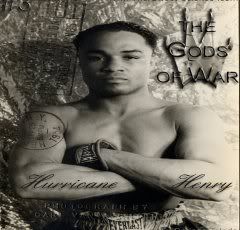
    The Third God of War: Henry Armstrong

    By Springs Toledo


    “Batten down the hatches…!”
    ~ Chambers Journal, 1883

    
Henry Armstrong’s grandmother was a slave in Mississippi. She was owned by his Irish grandfather whose eyes twinkled at the sight of her. Their son grew up and married a woman who was half-Cherokee. Her name was “America.” The couple had fifteen children. The eleventh, Henry, inherited his father’s short stature and his mother’s strength and work ethic.

    The family moved to St. Louis when he was still a small child. At sixteen years old, he put on his father’s cap and overalls and walked down to the Missouri-Pacific Railroad and got a job –driving spikes with a sledgehammer like John Henry. One day a fateful gust of wind carried a discarded newspaper to his feet: “KID CHOCOLATE EARNS $75,000 FOR HALF HOUR’S WORK,” the headline declared. He quit the job, ran home, and told his grandmother that he was fixing to be a champion of the world. She looked him up and down and said “you ain’t no Jack Johnson!”

    And she was right. The kid with the baggy overalls and a hammer in his hand would become something else, something greater than Jack Johnson.

    Henry Armstrong would become a force of nature in the boxing ring. Like those boll weevils that came up and under his family’s crops back on the plantation, he’d come up and under his opponent’s guard and do to ribs what those critters did to crops. Like the Tombigbee River that overran its banks and killed their cattle, he’d flood his opponent. Press row would watch his relentless attack and compared it to a hurricane…

    It began as a tempest in a teapot in 1931, when the underfed teenager lost three out of his first four professional fights. Over the next five years he fought seven draws and suffered eight more setbacks, but stronger frames were getting knocked over. Quite suddenly his elements converged with swirling momentum, and the forecast turned severe for anyone in his path. Between January 1937 and October 1940, Armstrong posted 59 wins, 1 heavily disputed loss, 1 heavily disputed draw, and 51 knockouts. In only three years and ten months, Armstrong fought 61 times. That’s exactly how many fights Muhammad Ali had over the length of his career; and they weren’t scale versions of “bums of the month” either –his blows had multiple contenders and seven Hall of Famers spinning sideways in the ring.

    Armstrong reached peak intensity the same year that one of the most powerful natural events in recorded history slammed into the east coast of the United States.

    The Great Hurricane of 1938 made landfall on September 21st and cut a swath through Long Island, New York, and New England. Only a junior forecaster saw it coming, but his frantic relay was slapped down by his superiors at the U.S. Weather Bureau who wrongly expected the storm system to continue on a seaward path. So there was no notice, no preparation. It hit Long Island at a record speed and changed the landscape of the south coast forever. Over the next three days, the Blue Hills Conservatory in Massachusetts measured peak gusts at 186 mph and 50 foot waves crashed into the Gloucester shoreline. By the time it was over and the statistics were computed, seven hundred people had died, 63,000 were left homeless, and 2 billion trees were uprooted.
    
“Hurricane Henry” cut another kind of swath –through three weight divisions. His three managers, the famous Al Jolson, film noir actor George Raft, and Eddie Mead, came up with an idea to pilot him toward three crowns. In an era where boxing recognized only eight kings, toppling three of them would be an unparalleled feat …if he could do it.

    This is what it would take, they told Henry, to compete with the rampaging Joe Louis in a depressed market. “It sounds pretty good to me,” he replied.

    THE WORLD FEATHERWEIGHT TITLE, 29 October 1937
    Petey Sarron had been a professional for a dozen years and looked it, wrote Paul Mickelson, “his eyes are cut, his ears are hard and flat, and he’s broken his left hand three times, his right once.” He also happened to be the National Boxing Association featherweight champion, and in his prime at twenty-nine.

    Madison Square Garden’s 1937-1938 boxing season opened with Sarron matched up against the twenty-four-year-old Armstrong for recognition as the world featherweight champion. Sarron trained at Pioneer’s gym in Manhattan while Armstrong trained at Stillman’s gym, which may partly explain the 2½ to 1 odds favoring the challenger –that or the fact that he was on a fifteen fight knockout streak. “This talk don’t scare me,” Sarron said, “I’m used to it. I found out in America, Africa, and Europe that nobody can beat me at 126 pounds.” Sarron was confident that Armstrong would fade. He reminded all and sundry that while he himself had gone fifteen rounds fifteen times, the challenger never had. “Armstrong isn’t fighting a punk this time,” he said.

    The veteran may have been expected to let youthful joie de vivre sap itself and then take over, but he defied that idea and waded boldly in to meet Armstrong on his own terms. He even managed to outland him with left hooks in the first round. He won the next few as well by inviting Armstrong to open up and then countering him. Armstrong made the mistake of trying too hard against a man who knew too much –he got stars in his eyes, went for a spectacular knockout, and got stars in his eyes. His wound-up shots breezed by the moving target although when they did happen to connect, they hurt. Before long, Sarron’s ribs began rattling like wind chimes under the blustering body attack, and by the fifth round his shutters were blown open. Armstrong mercilessly lashed him in a corner until the bell rang.

    A heavy right landed downstairs to begin the sixth and Sarron faced another surge. “Recovering somewhat,” The New York Times reported, “Sarron jumped at Armstrong and traded willingly with him.” His pride only preceded his fall. Armstrong shot a left to the body and then launched an overhand right that crashed on the champion’s jaw. Sarron “slumped to his knees and elbows” as if looking for a storm cellar under the ring, and was counted out.

    Petey Sarron fought a total of 151 times. The record indicates that he was stopped only once. Armstrong called the signature shot that did it “the blackout.”

    THE WORLD WELTERWEIGHT TITLE, 31 May 1938
    Armstrong’s managers intended to take the three world championship belts in an orderly fashion, but Al Weill, manager of the lightweight champion Lou Ambers, asked for a rain check. Welterweight king Barney Ross wasn’t about to give up a payday because of stormy weather.

    With a record of 72-3-3, Ross was an established master-boxer who, like Sarron, was never stopped. Born in New York City’s lower East Side, he stood second only to Benny Leonard among the celebrated Jewish champions who reigned from the 1910s through the 1930s and virtually disappeared after that. Barney Ross (nee Barnet David Rasofsky) was the last of the great ones.

    As a welterweight, he had not lost since the “Irish Lullaby” Jimmy McLarnin defeated him in 1934 –and Ross beat him before that bout and again after it. By the time he signed to face Armstrong, ennui had settled in because of the lack of challenges. He’d sneak tokes of a Chesterfield in the rubdown room and swig straight vodka at night after training. Not this time. Ross’s best fighting weight was 142 lbs and that was precisely what the scale said at the weigh-in. It was also the contractual limit for this match.

    Armstrong was having problems with the scale; simply put, he was no welterweight. In a sport where boxers ritualistically dried out, weighed in on the day of the fight, and then gorged at supper, Henry hurried to the scale with a belly full of water and beer, weighed in at only 133 lbs, and made off for the nearest toilet.

    The vast Jewish contingent in New York bet heavily on Ross, who entered the ring as a 7 to 5 favorite. The fistic fraternity was polled and Ross was favored by Jew and Gentile alike, 50-36, to outbox the smaller man.

    Every radio in the lower East Side was blaring as Barney Ross glided out of his corner at the opening bell. Working behind a varying jab and boxing at angles, Ross’s eyes were wide open in the early rounds as he strained to measure the bobbing and weaving whirlwind. Armstrong’s body attack was withering –he turned his fist around, crashed it into the champion’s ribs, and mixed it with left hooks and overhand rights. Ross’s strategy was to step inside the eye of the storm –inside the looping shots, and shift Armstrong off balance. The strategy was masterfully executed and Ross can be seen on film pivoting and turning Armstrong, but two problems soon became painfully clear.
    Last edited by IamInuit; 11-16-2012 at 04:45 AM.

Thread Information

Users Browsing this Thread

There are currently 1 users browsing this thread. (0 members and 1 guests)


Similar Threads

  1. STONE GODS!
    By El Kabong in forum Off Topic
    Replies: 9
    Last Post: 11-30-2007, 01:37 PM

Tags for this Thread

Bookmarks

  • You may not post new threads
  • You may not post replies
  • You may not post attachments
  • You may not edit your posts
  •  


Boxing | Boxing Photos | Boxing News | Boxing Forum | Boxing Rankings

Copyright © 2000 - 2025 Saddo Boxing - Boxing