
 Thanks:
  Likes:
  Dislikes:


 Re: Falling prices.....yay!
Well done Woti. This is still nonsense but it's the best reply I could hace expected seeing as you're defending a nonsense argument.Originally Posted by El Kabong

What you're saying here and in the previous post about "businesses doing well" is basically a load of boilerplate right wing ideology that you've been bombarded with over the years and now these claims have taken up permanent residence on your little shelf. But these things that you claim are all wrong. Clearly, demonstrably, diametrically wrong.
Before 1980 market economies since the advent of market economies hundreds of years ago had been governed by demand-side economics. Since before people even knew what demand-side economics were.
What are demand side economics? Make sure people had money in their pockets to buy goods and services and the market would take care of the rest. Whatever the demand was, for housing or clothes or food or appliances or gadgets or entertainment, if people created demand for a good or service the market would find a way to supply it.
And that worked fine until the late 1970s when two or three economists argued that if you slashed taxes for business owners and corporations and slashed regulation and oversight of their businesses -- to affect the supply side of the market system rather than concentrating on the damand side -- then we'd see a huge boom in investment which would supercharge the economy and create huge economic growth.
Back in 1980 this is how Reagan sold his tax cuts. Tax cuts and deregulation were going to unleash a wave of economic growth. But growth under Reagan was lower than under Carter or Clinton and significantly lower than 50s and 60s. Deficits and debt however skyrocketed, Reagan trebled the national debt in eight years as the tax cuts did not pay for themselves but created huge deficits.
But to the GOP these deficits are a feature not a bug. They mean they can make the case that government is too big and needs to be slashed to end the deficits. And then how to make the economy grow again after that? More tax cuts! And this has been their entire economic policy for 35 years now.
But did supply side economics unleash a wave of investment? No.
Investment actually reached a peak the year before Reagan took office (a time of 70% top tax rates) and has declined as a percentage of GDP ever since. The private spending graph is much more clear but FRED isn't co-operating today do none of my normal blue graphs.
But the other big claim of supply-siders was that a rising tide would lift all boats. Like you claimed, when businesses do well everybody else ends up doing well. How did that work in reality?
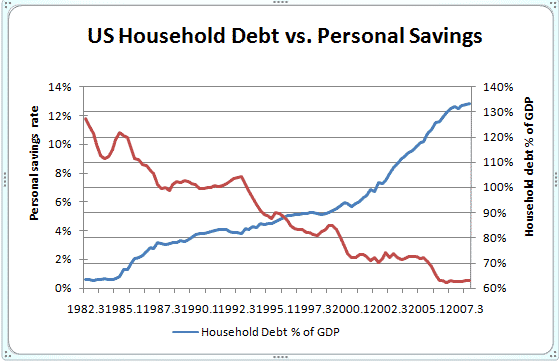
Income inequality goes through the roof since 1980. How about individual houeholds? How have they done in the supply side era?
Bugger. Savings depleted and debt through the roof of those households.
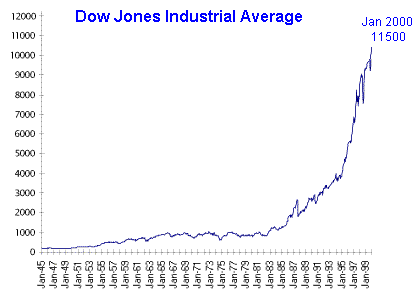
So all the money foe 35 years has gone to the top 1% and big business. If they didn't invest it what did they do with it?
So after 35 years of supply-side economics we've now got a very unbalanced economy with all of the surplus money going into capital markets where it creates volatility, bubbles and crashes. And until these markets and business in general is re-regulated and the money within the economy redistributed back to 1970s levels we're never going to see inequality improve or shared prosperity or solid economic growth.
Investor: Peasants Will Be Out With Pitchforks if We Don't Start Sharing the Wealth - Bloomberg Business
n the cur I told you all this back in 2007. The longer it takes the people running our economies and central banks to recognise their arrogance in believing they knew better than I did the more damage is going to be done to long-term global economic growth. Not to mention the potential pitchfork problem.
 |
|



 Reply With Quote
Bookmarks