 Re: Chuck Wepner
One spectator - watching via closed-circuit television in a Los Angeles movie theatre - was so inspired by Wepner's underdog pluck and the ninth-round knockdown of Ali, he rushed home to sketch out a character for a new screenplay he had in mind.
After his other screenplays were all canned and with a final chance to pitch a new idea, the writer returned to the draft, creating a redemption story about an over-the-hill boxer in a 'frenzied three-and-a-half-day flurry of creativity'.
The movie adapted from the screenplay went on to become the highest grossing film of 1976, a winner of three Oscars in 1977, a career launchpad for creator Sylvester Stallone and one of the most famous stories of modern times.
For Wepner, the man whose blood and bravery inspired the character of Rocky Balboa, it was just the start of the next chapter.
Short presentational grey line
At the Dennis P Collins Park, a strip of grassy playground on the banks of Newark Bay across the water from New York, the local mayor addresses the crowd.
"There are those from Jersey who are so famous we know them by single word names: there's Frank, there's Bruce and there's Chuck."
When the last name is mentioned in the company of Sinatra and Springsteen, the four hundred or so people in attendance cheer and applaud the local hero in their midst.
The man himself, dressed in yellow tracksuit and cap, nods and smiles from his position between boxing greats Larry Holmes and Gerry Cooney, who have also turned out to honour their friend on his big day.
As a brisk wind blows in across the water, the black cloth shrouding the soon-to-be-unveiled statue of a young Wepner flaps against the 2,500lb of bronze beneath.
"Well, I was actually born in New York," Wepner confesses. "I moved to Jersey when I was a year and a half old, after my mother and father split up. My mother raised us here in the projects after that."
And it was on the streets of Bayonne, a stone's throw from Collins Park - where dockers, mobsters and oil refinery workers mixed - that Wepner began to learn his trade.
"Where I grew up, there were always two or three gangs," he says. "And, more or less you had to go up there and beat up the toughest guy to survive, which I did. I'd have a fight almost every week."
And it wasn't just brawn. Wepner was a promising athlete too, playing for his high school basketball team in local tournaments. However, when he found out that "more money could be made beating up people", he committed himself to boxing.
A three-year stint in the marines held up his progress for a while - Wepner enrolled illegally at the age of 15 after seeing the movie Battle Cry and convincing his mother to add her signature to his "phony papers" - but when he entered the New York Golden Gloves amateur competition as a 220lb 18-year-old, he found it to his liking.
"I cut through those guys like butter; they'd never seen anything like my style before," he says.
In Madison Square Garden, Wepner broke the nose of local talent 'Bob the Pistol' and beat James Sullivan, a police department champ from Staten Island, on his way to the title of 1964.
He turned professional straight after, embarking on a 52-fight career that would see him victorious in 36 bouts and fighting such ring luminaries as Buster Mathis, George Foreman, Joe Bugner, Ernie Terrell and Muhammad Ali.
But it was his mid-career fight against Sonny Liston, in 1970, that Wepner felt would be his ticket to the big time.
"I thought I was gonna take a shortcut," Wepner says. "Well, it wasn't much of a shortcut for me, 'cause Sonny was too big and too tough.
"He broke my nose, gave me 71 stitches, and cracked my left jaw. I was still chasing him in the 10th round when the doctor stopped it because I was bleeding too much."
Aside from the broken bones, every stitch he received in his career was administered with nothing more than ice to quell the pain.
"Those hurt," he adds. "But I psyched myself up for it. Almost every fight, I knew I was gonna get cut. Eight or 10 stitches? That was just a nick!"
Being willing to die in the ring, Wepner admits, was another key piece to his armoury.
"Jesus, absolutely. I would go in there ready to die," he says. "Matter of fact, after the Liston fight, I was in a semi-coma and I was in shock; my doctor told my mother I was pretty banged up. I really thought about whether I wanted to continue. But then I thought, I gotta try, I gotta try again. I gotta give it one more shot."
He returned and, after two victories and three losses, Wepner then went on an eight-fight winning streak between 1972 and 1974 that brought him to Don King's attention.
King billed the bout between Wepner and Ali, at the Richfield Coliseum, as the "Give the White Guy a Chance" fight.
In a golden era of heavyweight boxing dominated by black men, King cynically felt he could draw a wider audience if Ali was pitted against a white American opponent for the first defence of his new reign.
But King's hope for a grudge match, a battle between the races, fell foul of Wepner's admiration for his opponent.
"You know, I was so thrilled and honoured to be in the ring with Muhammad Ali. The most famous man ever! I was so proud," Wepner says.
"Night before the fight, the owner of the Coliseum invites me and Ali to his private box for dinner. A big table and I'm sat right next to Ali. A couple hours sat together talking, he did a few magic tricks. I loved it. I loved Ali. We became great friends."
The following day, after James Brown blundered through the national anthem forgetting many of the words and turning the end of the song into a call-and-response with the audience, Wepner put aside his blossoming friendship with Ali and started putting into action a plan to win.
"My strategy was to press him, tire him out, at least for the first four or five rounds, maybe take him in the later rounds," Wepner says.
"So I pressed him, I threw body punches. I should've won three or four of those rounds. But the judges, with Ali, you gotta knock him out to beat him."
The crowd, expecting a drubbing of the challenger, started to respond to Wepner's unexpected guile. Instead of cheering "Ali! Ali!" they started getting behind the underdog, with shouts of "Chuck! Chuck!" echoing around the arena.
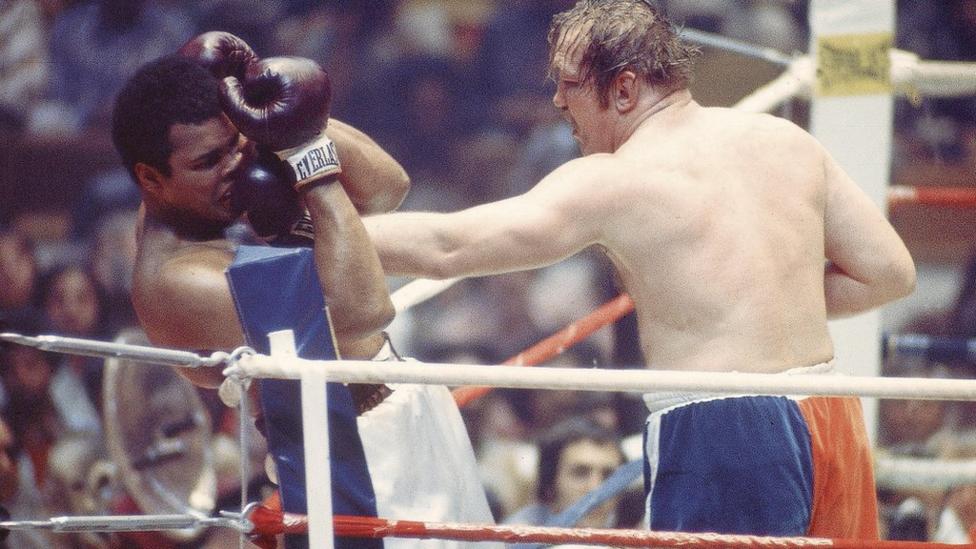
Buoyed by the support, Wepner had spotted a gap in Ali's defence. In the ninth round, he pounced to exploit it.
Wepner slipped under the champ's left jab to land a body shot with his right that sent Ali reeling back and on to the canvas.
Ali's corner later argued Wepner had tripped their man and Ali had lost his footing, but Wepner remains adamant.
"Strike me dead, I dropped him," he says. "I hit him with that punch and you can hear it on the replay, I Ianded solid all the way up to my shoulder. He was off balance and I dropped him and he knew it."
Watching Ali get back up from his position in the neutral corner, Wepner noticed a change.
He says: "I could see his eyes and I thought: I've really got him angry now! That's when he started counter punching and swearing at me."
Riled by the slight of being dropped, Ali relentlessly tore into Wepner, the crowd cheering for the underdog to hold on and go the distance.
Ali's punishment brought Wepner up 19 seconds short.
The fame that came from his epic defeat by Ali and his association with the Rocky movie placed Wepner's life on a new path.
In a bid to cash in, King arranged Wepner to 'fight' wrestling legend Andre Rene Roussimoff - more commonly known as 'Andre the Giant' - on an Ali undercard at New York's Shea Stadium. Wepner, albeit in a staged contest, lost after being counted out.
It was far from his most unusual opponent.
Later in his career, Wepner twice took on a performing bear called Victor in wrestling matches in a New Jersey bar.
Wepner was thrown across the ring after agitating the animal with repeated jabs to the head.
He took on other gigs, alongside his boxing work.
To bolster his work as a bar-to-bar salesman for Allied Liquor, he also "solved problems" for people who were owed money.
"Let's say I did a couple favours for friends of mine, you know," Wepner says. "I used to go around and ask people politely [about the money they owed] and then maybe I have to smack them in the face or something."
But after his retirement from boxing in 1979, things spiralled south. Wepner partied and took a lot of cocaine, a combination of which led to him failing an audition to appear in Rocky II alongside the now-superstar Stallone.
In 1985, he was convicted of possessing narcotics and sentenced to 10 years in jail, a verdict that sent him to Newark's Northern State Prison.
Prison would be the fight of many men's lives, but not for Wepner.
"Give me a break. It was fine," he says. "Everywhere I went, the guys were singing: 'Champ, Champ!' And saying to me: 'How are you doing, Chuck?'
"You know, I was with the right people [in prison], you might say - I wound up in a unit with some of the guys from the neighbourhood. I knew them, they knew me."
After volunteering to run the prison boxing team, a venture that failed because of a "lack of talent", Wepner was given parole after three years.
Then came the lawsuit against Stallone.
Do not let success go to your head and do not let failure get to your heart.

 Thanks:
  Likes:
  Dislikes:





 Reply With Quote
Bookmarks