
Ali, Boxing and the Silver Screen (II) – World Boxing Association
A few days ago, we published a brief piece touching on the long-standing relationship between boxing — one of the world’s most popular sports — and cinema, undoubtedly one of the entertainment industries with the strongest pull on the masses, who flock to movie theaters seeking a temporary escape from the pressures and demands of everyday life.
Today, partly in response to requests from dozens of friends and readers, we expand on that original discussion with a deeper historical perspective that was not previously explored. Once again, we lean on the work of Spanish writer Pablo Mérida in his book Boxing in Cinema, which chronicles a full century (1894-1994) of two activities deeply rooted in popular culture. And the story goes like this.
A VERY OLD STORY
“With the invention of photography at the end of the 19th century, a frantic race began to create a device capable of capturing and projecting moving images. The earliest discoveries amazed audiences, and very quickly the followers of this new invention developed preferences regarding the subjects they wanted to watch. Among the first were boxing matches.”
(Boxing in Cinema, by Pablo Mérida)
It is worth pointing out that boxing is unquestionably the most controversial sport in existence — condemned and defended in almost equal measure — but also the athletic discipline most frequently portrayed on the big screen. As we mentioned in our previous article, no other sport has inspired more films than boxing, an activity practiced by mankind for centuries and believed by historians to have originated roughly seven centuries ago in the Kingdom of Abyssinia, present-day Ethiopia and Eritrea.
Did you know that among the sports movies to win at least one Academy Award, the majority are boxing films?
Those titles include The Champ (1931), The Hustler (1961, winner for Best Black-and-White Cinematography and Art Direction), Rocky (1976, winning Best Picture, Best Director and Best Film Editing), Raging Bull (1980), directed by Martin Scorsese and earning Robert De Niro the Oscar for Best Actor, Chariots of Fire (1982), Million Dollar Baby (2004), which won Clint Eastwood the Oscar for Best Director, and The Blind Side (2009), centered on American football and starring Sandra Bullock in her Academy Award-winning performance.
Additionally, did you know that Thomas Alva Edison — the most prolific inventor in history, credited with nearly 1,000 patents including the phonograph, the incandescent light bulb, the dictaphone and the kinetoscope — played a key role in the origins and development of motion pictures, a creation later perfected by French brothers Auguste and Louis Lumière nearly fifteen years before the dawn of the 20th century?
One final question before we end the interrogation: Who is the athlete whose triumphs and struggles have most frequently been portrayed in film throughout the past century?
Yes — exactly the man you are thinking about and whom we referenced in our previous article: Muhammad Ali, “The Greatest.”
Born Cassius Marcellus Clay Jr. in Louisville, Kentucky, on January 17, 1942, and passing away in Scottsdale, Arizona, on June 3, 2016, Ali remains for millions the greatest heavyweight boxer of all time. The only fighter seriously mentioned alongside him in that conversation is the legendary Walker Smith Jr., better known worldwide as Sugar Ray Robinson, the incomparable superstar of the 1950s.
A FILMOGRAPHIC JOURNEY
Indeed, the boxing career and turbulent life of Ali have been brought to the screen in no fewer than ten documentaries and feature films, among them the following:
- The Fight (1971), chronicling the March 8, 1971 showdown at Madison Square Garden between Ali and Joe Frazier — both undefeated entering what became the true first “Fight of the Century.” Frazier won a 15-round decision and handed Ali his first professional loss. Ali had been attempting to reclaim the title stripped from him four years earlier after refusing military induction during the Vietnam War, famously declaring: “No Viet Cong ever called me a Negro.” His refusal resulted in a $5,000 fine, a criminal trial, and most painfully, the loss of the heavyweight crown he had won from Sonny Liston in 1964. Ali later defeated Frazier in their two rematches.
- Muhammad Ali: The Greatest (1977).
- When We Were Kings (1996), centered on the legendary “Rumble in the Jungle” on October 30, 1974, in Kinshasa, Zaire (now the Democratic Republic of the Congo), where Ali shocked the boxing world by knocking out George Foreman in the eighth round to reclaim the heavyweight championship in one of the sport’s greatest upsets. The documentary also features promoter Don King, dictator Mobutu Sese Seko, trainer Angelo Dundee, and assistant Drew “Bundini” Brown, creator of the immortal phrase: “Float like a butterfly, sting like a bee.”
- Body and Soul (1981).
- Ali: An American Hero (2000), a broad portrait of Ali not only as a fighter but as a social activist and defender of civil rights and Islam.
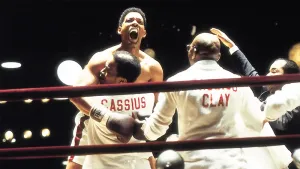
- Ali (2001), starring Will Smith as the iconic heavyweight champion, a role that earned Smith an Academy Award nomination for Best Actor.
- Through the Eyes of the World: Muhammad Ali (2001).
- Facing Ali (2009), another look at Ali both as a boxer and as an outspoken social figure in the fight against racism and for civil rights.
- The Trials of Muhammad Ali (2013), focusing on his legal battles after refusing military service during the Vietnam War.
- I Am Ali (2014).
To those titles should also be added Blood Brothers (2021), directed by Marcus Clarke, examining Ali’s complicated friendship with Muslim leader Malcolm X; Facing Ali (2009), featuring testimonies from many of his greatest rivals; and other documentaries and television miniseries chronicling the extraordinary life of a man whose legacy transcended sports.
There will be time to continue exploring this fascinating intersection between boxing and cinema, but for now, this should suffice.
Leave a comment
Be the first to leave a comment below — it will appear here and on our forum.