
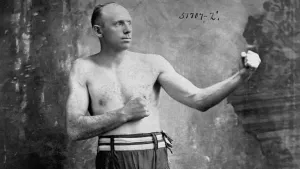
THE FIRST THREE-DIVISION KING – World Boxing Association
In the ever-growing list of fighters who have captured titles across multiple weight divisions—something once considered unthinkable in boxing’s early days—stand the names of legends such as Manny Pacquiao (an unmatched eight-division champion), Oscar De La Hoya (six), Sugar Ray Leonard (five), Thomas Hearns (five), Floyd Mayweather Jr. (five), Terence Crawford (five), and Roberto Durán (five). Countless others have ruled in four, three, or two divisions.
It’s a fascinating subject—one that deserves a deeper, dedicated study. That will come another day. Today, however, the focus is on a man who carved out a singular place in boxing history, back when the sport recognized only one champion per division across the traditional eight weight classes (now expanded to 17).
That man is Bob Fitzsimmons—the first fighter ever to win world titles in three different divisions. His feat, achieved in the late 19th and early 20th centuries, was nothing short of extraordinary. In today’s era of multi-division champions and undisputed titles, such accomplishments are more common—but no less compelling.
⸻
“THE FRECKLED WONDER”
Fitzsimmons, famously nicknamed “The Freckled Wonder,” also holds a unique place in boxing lore as the lightest man ever to win the heavyweight championship. Another reason to remember him today is that May 26 marks the anniversary of his birth in Helston, Cornwall, England. He passed away at age 54 in Chicago on October 22, 1917.
His first world title—the middleweight crown, his natural division—came on March 17, 1891, when he stopped Jack Dempsey in a brutal 13-round war in New Orleans. (This Dempsey, known as “Nonpareil,” is unrelated to the later heavyweight legend of the same name.)
Born Robert James Fitzsimmons—“Ruby” to his family—he emigrated at a young age to New Zealand, where he won the national amateur middleweight title in 1880 with four knockouts in a single night.
He later turned professional and captured the world middleweight title before making history again by becoming the first middleweight to win the heavyweight championship. That milestone came on March 17, 1897, when he defeated James J. Corbett, and he would later add the light heavyweight crown on November 25, 1903.
When Fitzsimmons faced Corbett, the defending champion weighed 184 pounds to Fitz’s 167—a gap of nearly 17 pounds. Yet the challenger prevailed. At 34 years old, Fitzsimmons stepped into the ring in Carson City, Nevada against “Gentleman Jim,” who had famously dethroned John L. Sullivan years earlier.
At the time, boxing was banned across much of the United States. Promoter Dan Stuart managed to secure approval by convincing authorities of the economic benefits. Each fighter earned $10,000 plus a percentage of the gate and film rights.
Fitzsimmons ended the fight in the 14th round with a devastating right hand to the solar plexus—one of the most famous body shots in boxing history. The bout was also historic for another reason: it became the first fight ever filmed, later shown in New York to a captivated audience.
⸻
“THE BIGGER THEY ARE…”
Fitzsimmons was beloved by fans for his fearless, almost reckless courage. He often joked—much to the delight of spectators—that he preferred fighting bigger men “because they make more noise when they fall.”
He made his public debut in January 1883, knocking out Jim Crawford in three rounds in Sydney, Australia. After compiling a record that included early setbacks, he moved to North America, where boxing was booming both in popularity and financial rewards.
He debuted in the United States on May 17, 1890, stopping Frank Allen in one round in San Francisco. What followed was a remarkable streak—32 consecutive knockout victories, including the title-winning win over Dempsey.
After defeating Corbett, Fitzsimmons lost the heavyweight crown two years later, stopped in 11 rounds by James J. Jeffries, who outweighed him by nearly 50 pounds.
Undeterred, Fitzsimmons returned to claim his third world title in 1903, defeating George Gardner over 20 rounds to capture the light heavyweight championship—cementing his place in history.
He later lost that title to Philadelphia Jack O’Brien in 1905.
Among his many contributions to the sport, Fitzsimmons was also a pioneer—introducing techniques such as switching stances mid-fight and lateral movement, both ahead of his time.
His later career included a knockout loss to Jack Johnson—the first Black heavyweight champion—and a brief return to Australia before finally retiring.
His record upon retirement stood at 61 wins (57 by knockout), 8 losses, and 4 draws, though some sources list alternative totals.
⸻
Fitzsimmons was inducted into the inaugural class of the Boxing Hall of Fame in 1954. He died of pneumonia at Chicago’s Michael Reese Hospital at age 54.
A Buffalo newspaper eulogized him with a poetic farewell: “A cruel death delivered the knockout blow to Bob Fitzsimmons in a Chicago hospital. The Great Referee called him to his corner—and from there, he never returned.”
Renowned boxing historian Nat Fleischer once described him as one of the hardest punchers in history, while writer Edgar Lee Masters said: “In courage, power, skill, and fighting spirit—no one in boxing history matched Fitz.”
Leave a comment
Be the first to leave a comment below — it will appear here and on our forum.